Reading UPUP-AI's Nine Modules Through APEC's Four Keywords
Drawing on the APEC logo's phrase 'distinct yet interdependent' and four publicly stated themes—openness, innovation, cooperation, and shared prosperity—this series explains, module by module, what specific problem each of UPUP-AI's nine modules solves. It is an analogy solely for understanding the product design, with no official affiliation.

Reading UPUP-AI's Nine Modules Through APEC's Four Keywords
Clarifying the Boundaries First
APEC is an intergovernmental mechanism for regional economic cooperation; UPUP-AI is a suite of enterprise software. The two have no affiliation, cooperation, or authorization relationship of any kind. What follows is a plain exercise: taking four terms APEC has publicly stated and using them as a mirror to reflect the design trade-offs behind an enterprise system.
The mirror is there to make the product easier to understand, not to burnish our own image. So the pages that follow avoid words like 'empower', 'enable', and 'join the grand occasion'; they state only 'what problem this module solves'.
I. The APEC Spirit: Four Keywords with Documented Sources
The main body of the 2026 APEC 'China Year' logo is a roc with outstretched wings, formed from 21 interwoven feathers. At its unveiling, Chen Xu, Chair of the Senior Officials' Meeting, said it 'vividly conveys the APEC spirit: 21 members, each distinct, yet interdependent and cooperative', and expressed the hope that it 'constantly reminds us of the strength of unity and collaboration among APEC members'. Source: Xinhua.net, 2025-12-12.
The 2026 theme is 'Building an Asia-Pacific Community to Promote Shared Prosperity', with three priority areas—'openness, innovation, cooperation'; APEC's purposes also include 'upholding free and open trade and investment'. Public statements repeatedly stress opposition to 'erecting walls and barriers' and 'decoupling and severing supply chains'. Sources: the Ministry of Foreign Affairs and the December 2025 Informal Senior Officials' Meeting.
One of the three priority areas. On November 13, the Ministry of Foreign Affairs stated that it looked forward to more practical outcomes in trade, connectivity, the digital economy, and artificial intelligence; among the more than 300 events held throughout the year were 10 specialized ministerial meetings. Source: Ministry of Foreign Affairs regular press conference, 2026-11-13.
④ Cooperation, shared prosperity
The latter half of the theme. In business circles, it appears as the summit theme 'Jointly Promoting Prosperity, Winning the Future Together', and as the inclusive orientation of 'letting the dividends of innovation be shared by more economies'. Sources: the Ministry of Foreign Affairs, the China Council for the Promotion of International Trade (CCPIT) / CCTV.
II. UPUP-AI in One Sentence
Compressed into a single sentence: it is not another ad-placement tool, but a way of turning a company's product information, external touchpoints, and content updates into a pathway that outsiders can read and insiders can keep current.
To borrow the logo's phrasing as an analogy—a company also has many 'feathers': its website, business cards, customer service, accounts across platforms, and the materials in every employee's hands. Each is distinct, yet what customers see is one and the same company. If these feathers each tell a different version of the story, they cannot fly together; what UPUP-AI does is weave them into an updatable whole.
III. Four Keywords × Nine Modules: What Problem Each Module Actually Solves
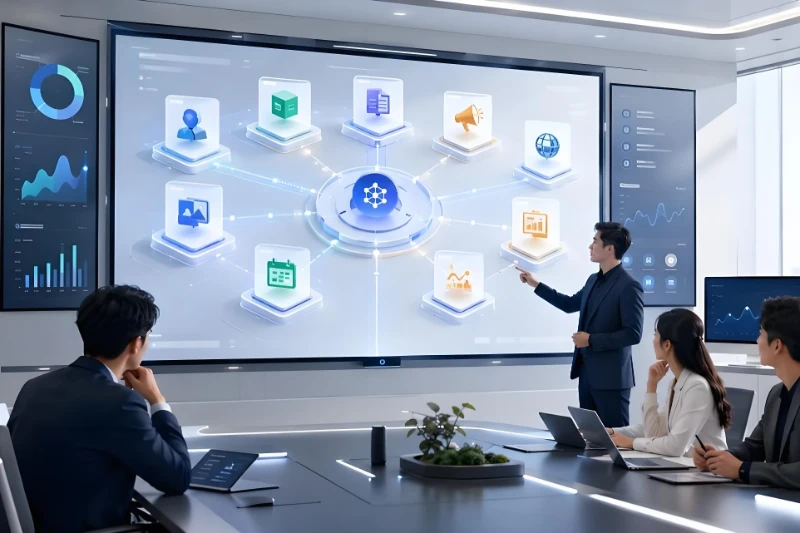
The following explains the 9 modules in the system's product library one by one. Each module covers only three things: what problem it solves, which principle it maps to, and why it is designed that way.
Keyword One: Distinct yet interdependent
- The problem: Machine-translating Chinese materials into English is not the same as 'doing business in the local language'; when each language page is maintained separately, an update to the Chinese version leaves the others behind.
- The alignment: Acknowledge differences rather than flatten them—the 21 members each have their own languages and rules.
- The trade-off: Native output in 18 languages plus a unified data source—secure 'one canonical version' first, then talk about 'having enough languages'.
- The problem: Buying a separate system for the website, business cards, customer service, knowledge base, and publishing backend leaves data siloed, accounts disconnected, and wording inconsistent.
- The alignment: Feathers must interweave to take flight; fragmented tools only pull in separate directions.
- The trade-off: Bring the work of six pieces of software into one system, making 'one and the same company to the outside world' the default state.
- The problem: Customers are added to a salesperson's personal WeChat; when that person leaves, the relationship breaks. The materials each employee sends out are also different versions.
- The alignment: The individual and the whole are interdependent—every employee is an outward-facing endpoint of the company, but the assets must belong to the company.
- The trade-off: Business cards are generated centrally by the backend and stay current as they are sent, so staff changes do not affect what customers see.
Keyword Two: Openness
- The problem: The website lacks structured data, so once buyers start asking AI instead, the company simply does not appear in the answers.
- The alignment: Information should not be locked inside one platform; it should be freely readable and accurately citable.
- The trade-off: Site-wide structured semantics, Schema.org markup, and automated Sitemap submission turn 'being machine-readable' into infrastructure.
- The problem: Once content is written it has to be moved to the website, the official account, the Mini Program, and the knowledge base, with edits at every move—so updates simply stop.
- The alignment: No walls—use open standards to meet the tools employees already use, rather than making everyone switch to a new system.
- The trade-off: Built on the open MCP protocol, employees update directly from tools such as WorkBuddy, Claude Desktop, and Cursor.
- The problem: Overseas customers will not install an App just to view a business card; contact stalls at the very first meter.
- The alignment: Lowering the other party's barrier is what openness really means.
- The trade-off: The Mini Program card serves the domestic market and the global Chinese community, while the 18-language H5 card targets overseas customers with no installation required and native fit with the channels they already use.
Keyword Three: Innovation
- The problem: Traditional websites built before 2026 lack structured data and are nearly invisible in AI search.
- The alignment: When the entry point changes, the infrastructure has to change with it—this is the most practical layer of 'innovation'.
- The trade-off: Build on 18-language internationalization, semantic tags, Open Graph, and structured data as the foundation, rather than merely swapping in a new visual design.
- The problem: Cross-time-zone inquiries fall on individual salespeople, with no one covering nights and holidays; high-frequency questions get rewritten from scratch every time.
- The alignment: Apply technology where it is least visible yet most decisive for closing a deal.
- The trade-off: An agent and customer service working as dual engines, with DeepSeek and Hunyuan as primary and secondary, answers drawn from the company's own knowledge base, 7×24 multilingual responses in seconds, and the vast majority of inquiries resolved on the spot; when human judgment is needed, the handoff carries full context so service never breaks.
Keyword Four: Cooperation, shared prosperity
- The problem: As markets multiply, the materials on the website, on platforms, and in salespeople's hands turn into several different versions.
- The alignment: Shared prosperity requires acting in unison; publishing separately only undercuts everyone.
- The trade-off: One backend governs all digital assets, with a single publish syncing to 80+ mainstream platforms; the accompanying 20 industry solutions and 12 case studies exist to acknowledge that different industries are 'distinct', not to impose one-size-fits-all copy everywhere.
IV. How to Read These Six Articles
- ① Multilingualism and comprehensibility: starting from over 100,000 foreign-language signs → Modules 1, 7
- ② AI answers become the new entry point: starting from the digital economy and artificial intelligence agenda → Module 4
- ③ Business cards and touchpoint assets: starting from 147 companies attending → Modules 3, 6
- ④ Cross-time-zone response: starting from simultaneous interpretation in 8 languages → Module 8
- ⑤ Full-platform publishing and version governance: starting from the +40% trade growth → Modules 9, 2
- ⑥ Agent integration and content orchestration: starting from more than 300 events → Module 5
All six articles 'first make a point that is useful to companies, then close with a brief note on how such capabilities are implemented'. They are not written in the order of a product manual, and they do not treat the meeting as an endorsement.
V. Information and Sources
- Xinhua.net, 2025-12-12: 'What Does the 2026 APEC China Year Logo Mean? An Explanation' (21 feathers, APEC spirit wording) — http://www.xinhua.org/20251212/1d1dad261ca34e259c55c672e8497cfe/c.html
- Ministry of Foreign Affairs regular press conference, 2026-11-13 (theme, priority areas, digital economy and artificial intelligence) — https://www.mfa.gov.cn/fyrbt_673021/202611/t20261113_12058837.shtml
- Ministry of Foreign Affairs regular press conference, 2025-11-03 (multilateralism, regional economic integration) — https://www.mfa.gov.cn
- Ministry of Foreign Affairs, 2026-11-04: Ambassador to Thailand on the three proposals of 'openness, innovation, cooperation' — https://www.fmprc.gov.cn/zwbd_673032/wjzs/202611/t20261104_12053011.shtml
- APEC purposes and membership information compiled from public sources — https://baike.baidu.com/item/APEC%E6%88%90%E5%91%98/69300020
- Capability descriptions of the 9 modules are taken from the UPUP-AI system product library (read via upupai MCP, 2026-11-15).